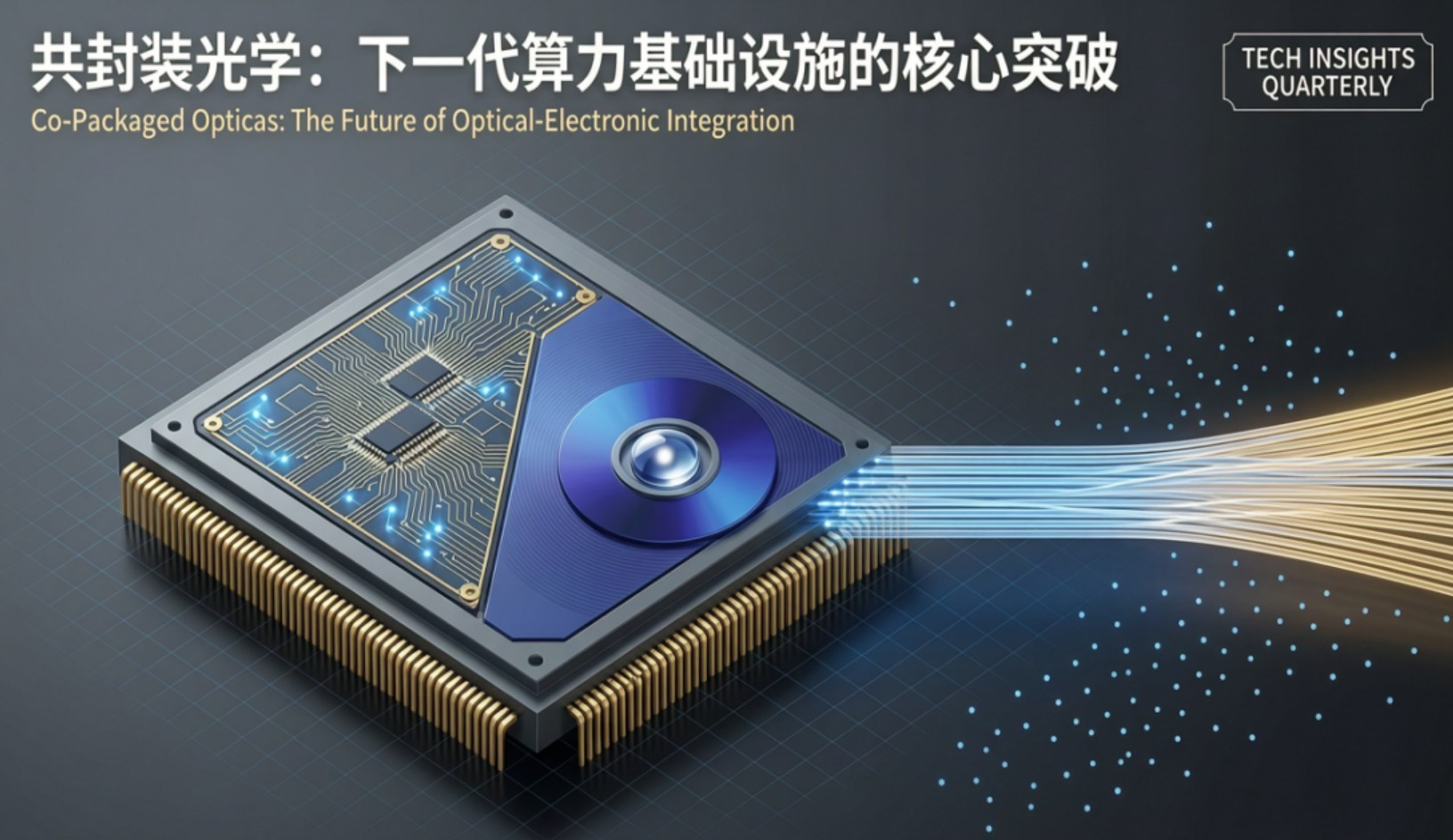
As GPU clusters scale beyond 10,000 cards, the power and bandwidth limits of copper interconnects can no longer be ignored. Co-Packaged Optics (CPO) integrates optical engines directly into switch chip packages, replacing electrons with photons for chip-to-chip communication. From Broadcom Tomahawk 5 to NVIDIA NVLink optical interconnects, CPO is moving from concept to volume production. Where do you see CPO making the biggest impact first — data center switching or AI training clusters?
1. When Copper Hits Its Limit
Traditional data centers rely on copper cables for short-reach chip-to-chip interconnects. But as per-lane speeds climb from 25G to 112G and then 224G, signal attenuation, crosstalk and power consumption in copper degrade sharply. A 224G copper link is effective over less than one meter, yet a 10,000-card AI training cluster demands thousands of high-speed links — power, cooling and cable density all hit red. The industry needs a fundamental answer: replace electrons with photons.
2. What Is Co-Packaged Optics (CPO)?
The core idea of CPO is to co-package optical engines (lasers, modulators, photodetectors and other optoelectronic devices) with switch ASICs or GPUs on the same substrate. Optical signals undergo electro-optical conversion right inside the package, connecting to remote chips via fiber — eliminating the long copper traces and multiple signal repeaters found in traditional pluggable optical modules. This delivers three benefits: 30-50% power reduction, several-fold bandwidth density improvement, and significantly lower link latency.
3. Key Players: From Lab to Volume Production
Broadcom launched its Tomahawk 5 switch chip (51.2T) with integrated CPO in 2023, already delivered to leading cloud providers for validation. NVIDIA demonstrated its NVLink optical interconnect at GTC 2024, integrating silicon photonics into GPU packages to support all-optical interconnects for 10,000-card clusters. Intel, leveraging its mass-production silicon photonics experience, has shipped over 20 million silicon photonic chips and provides foundry services for multiple CPO solutions. TSMC and ASE offer advanced 2.5D/3D packaging platforms on the integration side, supporting heterogeneous integration of optical engines with ASICs.
4. Final Thoughts
From pluggable to co-packaged, optical interconnects are undergoing an architectural-level transition. CPO is not a simple upgrade to optical modules — it is the deep convergence of chip design, packaging technology, optical components and system architecture. For the semiconductor and optical communications industries, this represents both a technical challenge and an opportunity to redefine the value chain.